

Business Auto & Fleet Insurance
Company vehicles, one or fifty, plus the employees who drive their own cars for work.
Any business with a vehicle in the operation.
Whether a business runs one commercial vehicle or an entire fleet, the exposure comes from the same place: someone driving on behalf of the business.
- Businesses with a vehicle titled to the company rather than to a person.
- Operations financing or leasing vehicles, where the lender requires physical damage coverage.
- Fleets that change through the year, gaining and losing units.
- Any employer whose staff run errands, make deliveries or visit clients in their own cars.
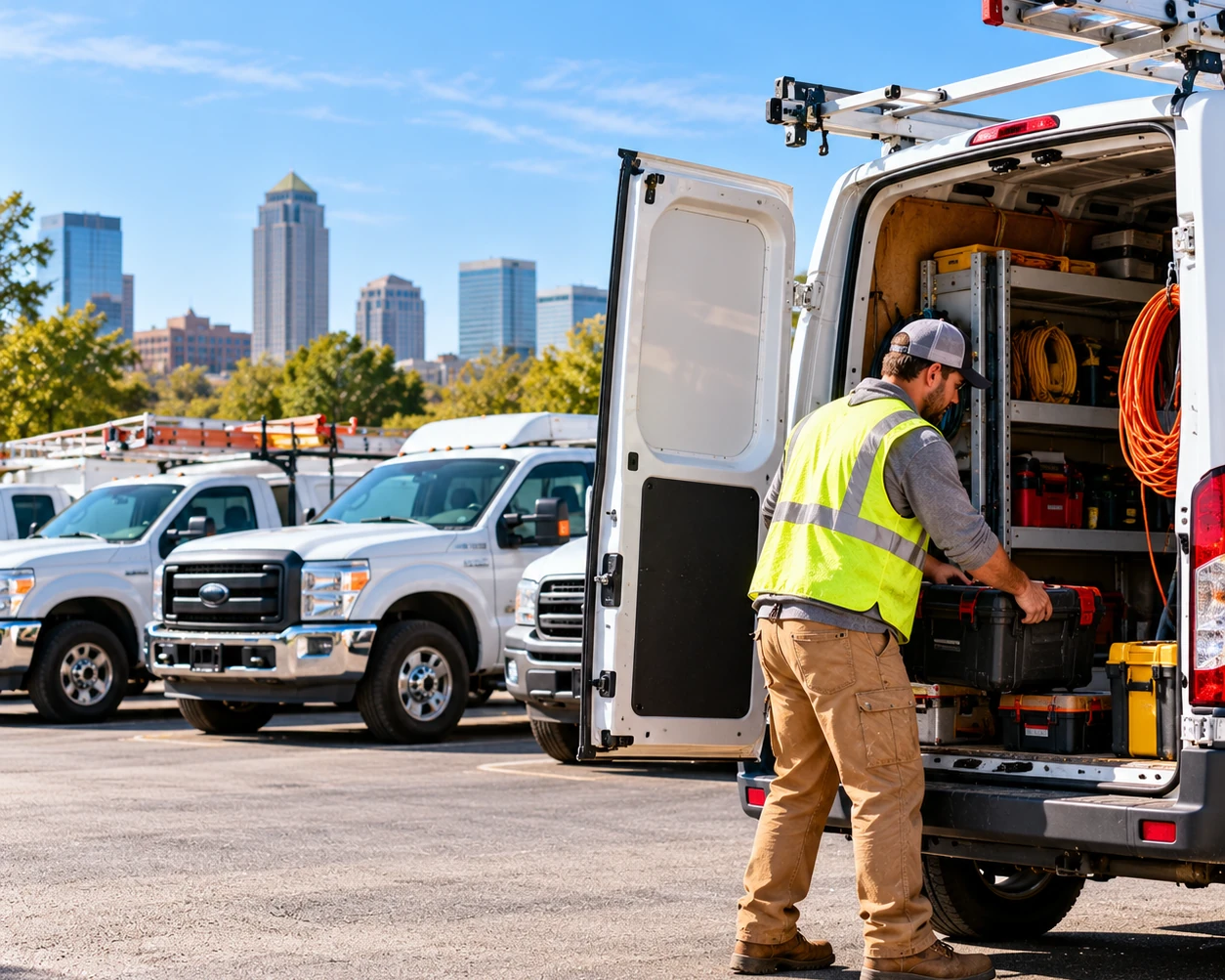
A collision is never good news. A collision in a vehicle titled to your business is a more complicated problem.
Business auto insurance takes the parts of a personal auto policy and writes them for an organization instead of a household. The coverages look familiar: liability for bodily injury and property damage, collision for damage to your own vehicles, coverage for named perils such as fire and theft, uninsured and underinsured motorists coverage for your own driver's injuries when the person at fault has no coverage or not enough of it, and roadside assistance where it is added. What changes is the size of what stands behind a claim.
Liability limits on a commercial policy are usually written much higher, for the plain reason that a business typically has more assets exposed to a judgment than an individual does. A vehicle registered to the business also does not belong on a personal auto policy, which is written around personal ownership and personal use.
Where commercial auto claims get serious.
What separates a company vehicle from a family one.
- The business is the defendant. A claim arising from an accident in a company vehicle is brought against the business, and everything the business owns sits behind the liability limit. That is why commercial limits are written where they are, and why a commercial umbrella usually attaches here.
- An employee's own car becomes your claim. The employee's personal policy responds first, with the limits an individual chose. When those are exhausted and the business is named, non owned auto liability is what stands between the claim and the company.
- The new truck was not on the policy. Fleets change constantly, and a unit that was never reported is the most avoidable gap on this line.
- Who is driving is part of the risk. A policy that lets any employee take any vehicle is convenient, and it also means the business's exposure is only as good as its driver standards.
The decisions that shape the policy.
Most of what this line costs is decided by how the vehicles are used, not by what they are worth.
- Set liability against the balance sheet. The limit should reflect what a judgment could reach, not what the vehicle is worth. A commercial umbrella above the auto policy is the usual way to reach the figure a business actually needs.
- Decide physical damage vehicle by vehicle. Collision and comprehensive are required on financed and leased units and optional on the rest, and the answer can reasonably be different for a new van and an old pickup.
- Cover the non owned exposure before it comes up. If anyone drives a personal car for the business, even occasionally, that exposure exists. It is straightforward to address deliberately and awkward to address after a claim. Hired auto coverage does the same job for vehicles the business rents or borrows.
- Keep the schedule and the driver list current. Vehicles added, vehicles sold, drivers hired and drivers gone. This is the single most common maintenance item on a fleet account, and it is a phone call rather than a new policy.
- What drives the cost. The types of vehicles insured, how they are used, their value, the coverage options selected, the safety equipment fitted and the account's own claim record. Real safety standards and a clean record are what produce savings on this line over time.
Business auto questions we hear most
Can I just put the company truck on my personal auto policy?
Generally no. A personal auto policy is written around personal ownership and personal use. A vehicle titled to the business belongs on a business auto policy, and doing it the other way risks a coverage dispute at exactly the wrong moment.
My employees use their own cars for work. Am I exposed?
Yes. If an employee causes an accident while driving for the business, the business can be named in the claim. Non owned auto liability, added to the business auto policy or written separately, is the coverage for that.
Does non owned auto coverage repair my employee's car?
No. It protects the business against liability arising out of a vehicle the business does not own. Damage to the employee's own vehicle remains a matter for the employee's own policy.
How does a fleet policy differ from insuring each vehicle?
It is one contract covering every company owned unit, which is generally easier to administer and more cost effective than separate policies. Vehicles can be added or removed as the operation changes, and coverage can be arranged so any employee may drive any vehicle.
What happens when I buy another vehicle mid-term?
It is added to the policy. Policies do contain provisions for newly acquired vehicles, but those provisions have their own conditions, so reporting the purchase rather than relying on them is the safer habit.
- General Liability Insurance
- Business Owners Policy
- Commercial Property Insurance
- Workers Compensation Insurance
- Business Interruption Insurance
- Professional Liability & E&O
- Cyber Liability Insurance
- Employment Practices Liability
- D&O & Management Liability
- Commercial Umbrella Insurance
- Crime Insurance
- Builders Risk Insurance
- Inland & Ocean Marine Insurance
- Surety & Commercial Bonds
- Liquor Liability Insurance
- Environmental Insurance
- Risk Management
Let's put the right policy in place.
Oxford Risk LLC is an independent agency. We represent you rather than a single carrier, which means we can place your coverage with the company whose appetite actually fits your risk. Tell us what you need to protect and an advisor will take it from there.
- Call (330) 315-3081
- Hours Monday - Friday: 8:00 AM - 4:00 PM
- Offices Fairlawn, OH, Cranberry Township, PA, Columbus, OH, Livonia, MI