

Business Interruption Insurance
The property policy repairs the building. This is the coverage that pays for the months it is closed.
Businesses that cannot simply pause.
The coverage matters in proportion to how much of a business's income depends on one place, one piece of equipment or one supplier.
- Operations tied to a physical location customers come to.
- Businesses with payroll, rent and loan payments that continue whether or not revenue does.
- Manufacturers and anyone dependent on a single supplier or a short list of them.
- Businesses whose work stops entirely without power, water or gas.
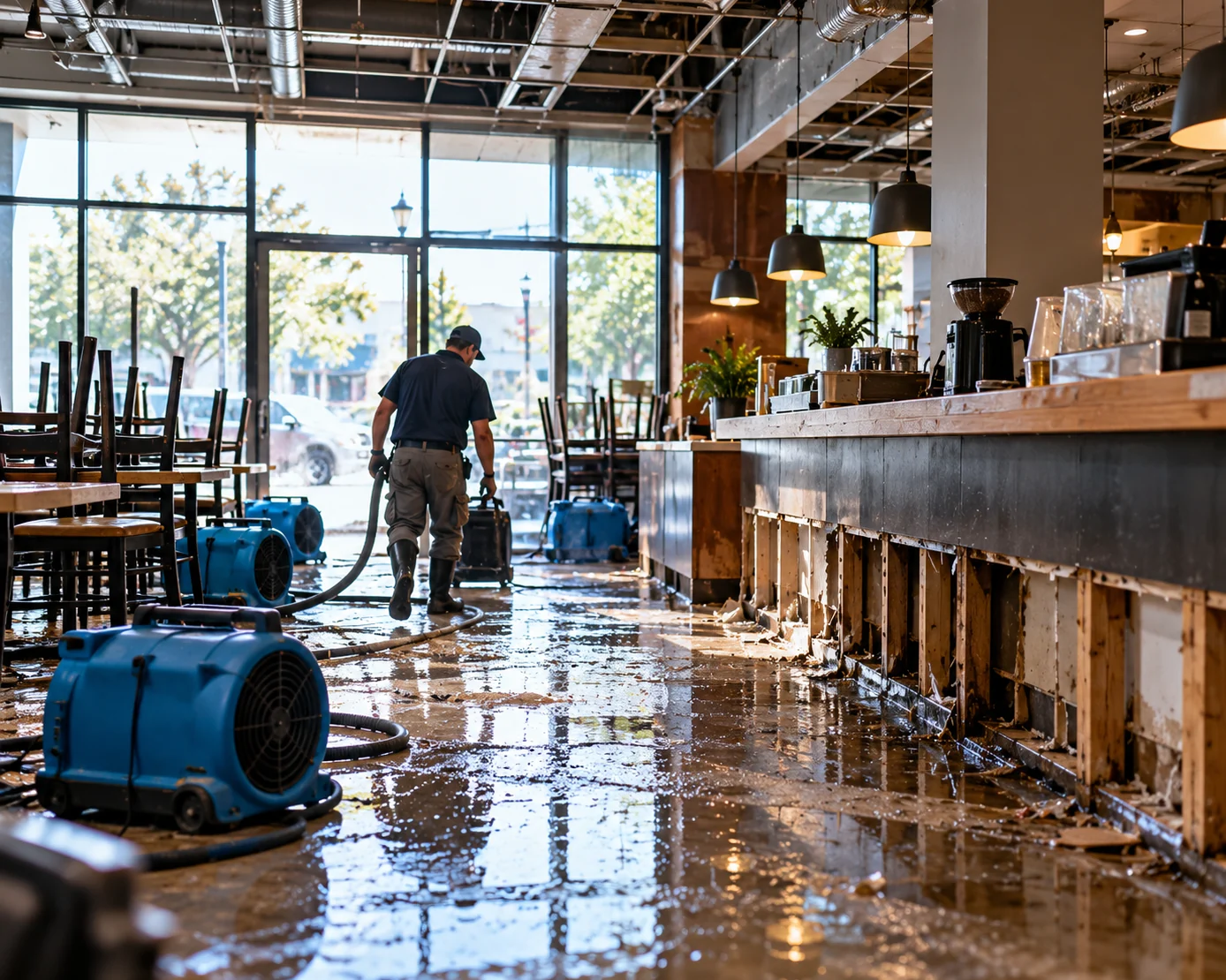
Property coverage answers what the loss broke. Business interruption answers what the loss stopped.
Business interruption insurance, sometimes called business income interruption insurance, responds when a covered loss forces a business to stop operating. For a set period while repairs are made, known as the restoration period, it covers the income the business would have earned and the costs that do not pause simply because the doors are shut.
It is a time element coverage, which means it is triggered by physical loss or damage that the property policy covers, and then measured in time rather than in things. That distinction is the whole coverage: a closure with no covered physical damage behind it generally does not trigger it, which is why the specific extensions below exist.
What a closure actually costs.
The expenses that keep running after the revenue stops.
- The fixed costs do not wait for the repairs. Rent or the mortgage, loan payments, taxes and the payroll of the staff a business intends to keep all continue through a shutdown. They are the reason a covered property loss can end a business that was properly insured for its building.
- Reopening costs more than staying open. A temporary location, overtime, additional staff, replacement equipment and retraining are all costs above the ordinary run rate, incurred precisely when there is no income. Extra expense coverage is written for that.
- Someone else's loss can close you. A fire at a supplier, a failed partner, a shipment that cannot move. The damage is not yours and the lost income is, which is the gap contingent business interruption fills.
- A shutdown with no damage is a different question. An order to close, or a loss of utilities, can stop a business without touching its property. Those situations are covered only through the specific extensions written for them, and those extensions carry conditions and short time limits.
The decisions that shape the coverage.
This is one of the few coverages where the arithmetic behind the limit matters as much as the wording.
- Work out how long a rebuild would really take. The restoration period is the time reasonably required to repair or replace, not the time it takes for revenue to recover. Permitting, lead times on custom equipment and a contractor's schedule all belong in that estimate.
- Build the limit from income and continuing expenses. Projected revenue for the period, plus the costs that keep running while the doors are closed, is the basis. A convenient round figure is how a claim ends mid-rebuild.
- Consider the period after you reopen. Revenue does not return on the day the doors open. Extended business income coverage addresses the recovery period after operations resume, and it is a separate election.
- Decide whether extra expense is worth more than income. For some businesses, spending to reopen quickly is worth far more than being paid to stay closed. The balance between income and extra expense coverage should reflect which of those is true for you.
- Name the dependencies you cannot replace. Contingent business interruption is most useful where it reflects the actual suppliers, buyers and carriers the business cannot operate without.
- Expect a waiting period. Many forms do not begin paying until the interruption has lasted a stated number of hours, so short outages are generally the business's own to absorb.
Business interruption questions we hear most
What has to happen before this coverage pays?
There generally has to be physical loss or damage the property policy covers, and that damage has to be what stopped the business from operating. The coverage is then measured by time: the period reasonably required to repair or replace what was damaged.
Are we covered if we are ordered to close?
Only through civil authority coverage, and it has conditions. It generally applies where the order follows physical damage to an adjacent property the business does not own, and it typically pays for a limited period, often up to two consecutive weeks. A closure ordered for reasons unconnected to that kind of damage is generally outside the coverage.
What if a supplier's loss shuts us down?
That is contingent business interruption, also known as dependent properties coverage. It responds when a covered loss at property the business does not own reduces or stops its income, and it can be arranged for suppliers, providers, buyers and the carriers that move goods.
Does it pay if we lose power?
Utility services coverage is the part written for that, covering the interruption when gas, water or electricity from a public or private company is lost. Depending on the form it lasts for a set period or until service is restored, and some versions also cover direct damage caused by the utility failure.
- General Liability Insurance
- Business Owners Policy
- Commercial Property Insurance
- Workers Compensation Insurance
- Business Auto & Fleet Insurance
- Professional Liability & E&O
- Cyber Liability Insurance
- Employment Practices Liability
- D&O & Management Liability
- Commercial Umbrella Insurance
- Crime Insurance
- Builders Risk Insurance
- Inland & Ocean Marine Insurance
- Surety & Commercial Bonds
- Liquor Liability Insurance
- Environmental Insurance
- Risk Management
Let's put the right policy in place.
Oxford Risk LLC is an independent agency. We represent you rather than a single carrier, which means we can place your coverage with the company whose appetite actually fits your risk. Tell us what you need to protect and an advisor will take it from there.
- Call (330) 315-3081
- Hours Monday - Friday: 8:00 AM - 4:00 PM
- Offices Fairlawn, OH, Cranberry Township, PA, Columbus, OH, Livonia, MI