

Umbrella Insurance
Every policy you own has a liability limit. This is the coverage that starts where those limits stop.
Anyone whose liability limits are smaller than what they own.
The usual reason to add an umbrella is that the liability limits on the main policies are too low for what a serious claim could reach. Nothing about the coverage is exotic; it is the same liability protection, continued further.
- Households whose assets are worth more than the liability limits on their auto and home policies.
- Families with more than one driver, where any one of them can create a claim that reaches everyone's assets.
- Boat owners, since a watercraft policy carries its own liability limit and an umbrella can sit above it.
- Anyone who has already raised their auto and home liability limits and wants coverage beyond where those limits end.
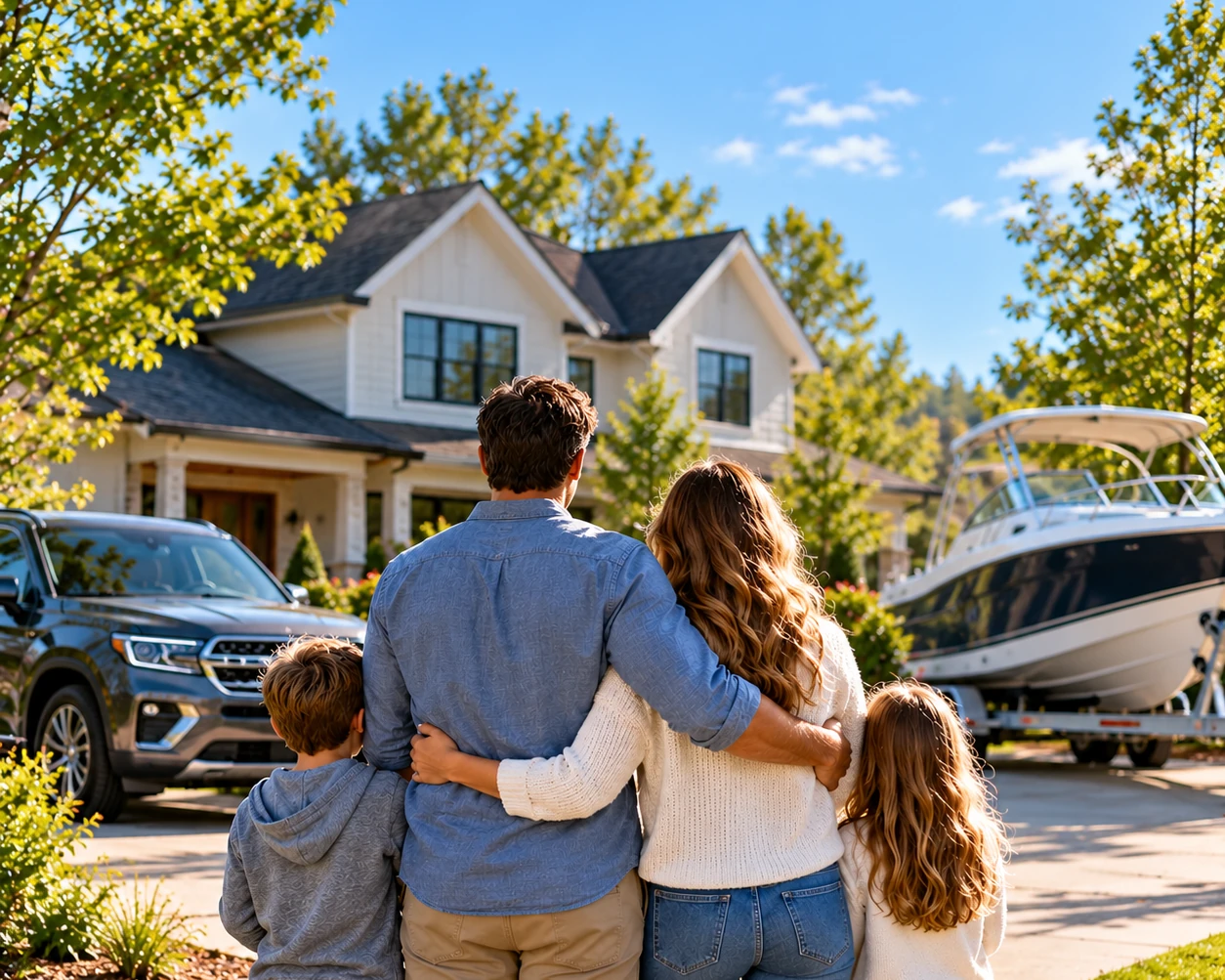
A liability claim does not stop at your policy limit. Your money is what is past it.
An umbrella policy is an additional liability policy that sits above the ones you already have. It is most commonly bought alongside auto and home insurance, and it can sit above a watercraft policy as well.
It is specifically about liability: the cost you may owe somebody else for an event you are held responsible for. It does not usually cover losses you bear yourself, so damage to your own property and theft of your own possessions are not what it is for.
Where a primary limit runs out.
The claims that exceed a policy limit are rare, and that is exactly why the limit is usually set too low.
- A serious injury claim has no ceiling. Your policy has a limit. The claim does not. Medical treatment, lost wages and legal costs behind one bad accident can pass an auto liability limit, and everything beyond it is your own money.
- Each policy has its own separate ceiling. Auto, home and watercraft each stop at their own liability limit. An umbrella is the one place those separate ceilings can be raised together rather than one policy at a time.
The decisions that shape the policy.
An umbrella is a simple policy with a small number of consequential choices.
- Set the underlying limits first. The umbrella does not respond until the policy beneath it has paid in full, so the auto, home or watercraft limit determines where your additional coverage begins. Those limits and the umbrella are one decision, not two. Because the umbrella is asked to pay far less often than a primary policy, a large amount of additional liability coverage usually costs less than people expect.
- List everything the umbrella should sit above. Auto and home are the common pairing, and a watercraft policy can sit under it too. A liability exposure left off the schedule is a gap the umbrella will not fill.
- Confirm who is covered. Family and household members may be included. The definition varies, and it is worth reading rather than assuming, particularly in a household with young drivers or relatives living there.
- Understand what it does not do. This is liability coverage. It does not pay for damage to your own property or for your own stolen possessions. Those belong to the home, auto or watercraft policy.
- Read the wording, not the label. Umbrella and excess liability are used loosely across the market. Whether a policy only raises the limit or also reaches situations the underlying policy excludes is answered by its terms, not its name.
Umbrella questions we hear most
How does an umbrella policy actually pay a claim?
It waits. The auto, home or watercraft policy pays up to its liability limit first. If the covered cost continues past that limit, the umbrella pays the remainder, up to its own limit. It never pays before the policy underneath it is exhausted.
Is an umbrella policy the same thing as excess liability?
Not always, and the terms are used interchangeably often enough that the label alone is not reliable. The distinction some insurers draw is that an umbrella can reach certain risks and situations the underlying policy does not cover, while excess liability simply adds a higher payout limit. Since the usage is inconsistent, the policy wording is what settles it.
Does an umbrella cover damage to my own house or car?
No. It is liability coverage, which means it responds to what you may owe someone else. Damage to your own property and theft of your own possessions stay with your home, auto or watercraft policy.
Are my family members covered?
Often yes. Umbrella policies commonly extend to family or household members, but the definition of who counts differs from policy to policy. It is one of the few things on this coverage worth checking in writing.
- Home Insurance
- Condo Insurance
- Renters Insurance
- Mobile Home Insurance
- Flood Insurance
- Auto Insurance
- Classic Car Insurance
- Motorcycle Insurance
- RV Insurance
- Off-Road & Recreational Vehicle Insurance
- Boat & Watercraft Insurance
- Life Insurance
- High Net Worth Insurance
- Pet Insurance
- Event & Special Event Insurance
Let's put the right policy in place.
Oxford Risk LLC is an independent agency. We represent you rather than a single carrier, which means we can place your coverage with the company whose appetite actually fits your risk. Tell us what you need to protect and an advisor will take it from there.
- Call (330) 315-3081
- Hours Monday - Friday: 8:00 AM - 4:00 PM
- Offices Fairlawn, OH, Cranberry Township, PA, Columbus, OH, Livonia, MI