

Manufacturing & Distribution Insurance
Businesses that make, store, move or resell physical goods, and the claims that follow the goods.
Anyone in the chain between raw material and end user.
The industry runs from a shop making parts to a customer's drawing all the way to a redistributor that never touches a production line. The coverages overlap heavily; the weighting does not.
- Manufacturers producing and distributing their own products.
- Machine shops and precision fabricators working to customer specification.
- Warehouse and logistics operations, including distribution and fulfillment centers.
- Wholesalers and distributors across auto, clothing, computer, electronic, furniture, construction material, medical equipment and food sectors.
- Food distributors, whether broad line, specialty, cash and carry or redistribution.
- Equipment rental businesses, from small tools to heavy machinery.
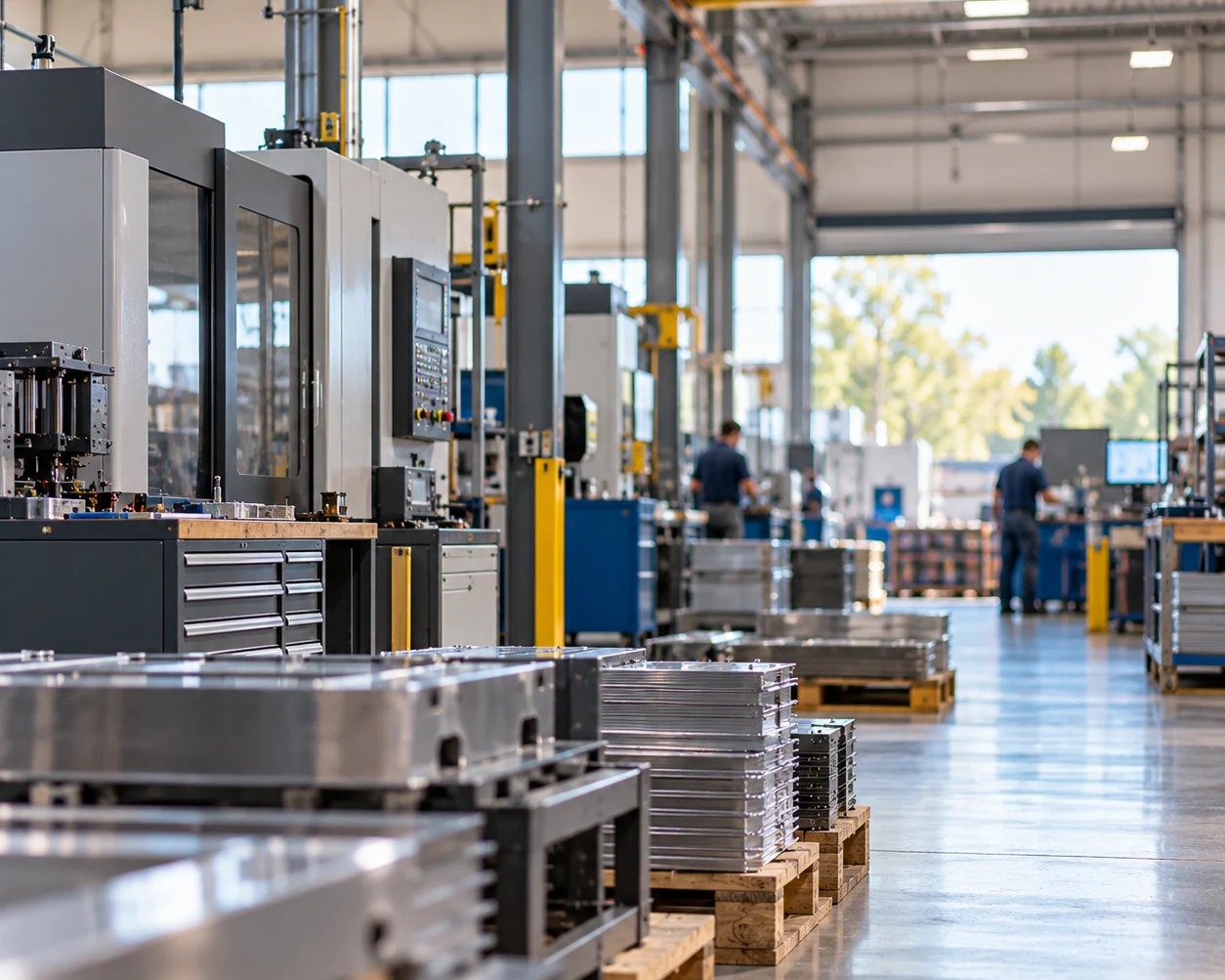
The product leaves the building. The liability for it does not.
If you make, warehouse, distribute or rent out physical goods, standard business insurance is usually built for the wrong half of the risk. It handles the building, the stock and the people. What it handles poorly is the product itself once it is in someone else's hands, the specialized equipment the operation depends on, and the goods of other businesses sitting in your custody.
Those three exposures are what unify a machine shop, a fulfillment center, a food distributor and an equipment rental yard. All four carry product and recall risk, all four have high value property concentrated in one place, and all four can be shut down by a single machine that stops working.
The exposures that define this industry.
Physical goods create liability in more directions than most business owners expect.
- A defect becomes a claim, and the claim becomes a recall. If a product is defective and injures someone or damages their property, the business that made it can be held liable, and the response often includes pulling the product from the market.
- Distributing a product you did not make still reaches you. Being the distribution link in the chain does not put you outside a product claim. Wholesalers, distributors and rental businesses can all be named over goods they did not manufacture, which is why product liability and recall belong in a distribution program and not only in a factory's.
- Equipment failure is the shutdown nobody budgets for. A conveyor, sorter, forklift, press or refrigeration unit that simply stops working can halt the operation while sitting undamaged in the usual sense.
- Stock is concentrated value. A full warehouse means large amounts of inventory in one place, which raises the financial consequence of fire, water damage and theft well beyond what the square footage suggests.
- Goods in your custody belong to someone else. Warehouses hold their customers' stock, and rental businesses send their own equipment out into customers' hands. In both cases property is being looked after rather than owned, and the coverage question is liability for that property rather than ownership of it.
- An administrative error can breach a contract. Inventory tracking, order processing and shipment scheduling all leave room for error, and a late shipment can put a business in breach and on the hook for its customer's losses.
- Some processes leave something behind. Solvents, chemicals and paints used in production can contaminate air, soil and water on and around a site, and the damage can travel far enough to create a third party claim. Environmental coverage is what addresses cleanup cost, damages and legal fees for those incidents.
The decisions that shape the program.
Most of the value in this industry sits in four places: the product, the stock, the machines and the downtime.
- Set property limits against a full facility. Buildings, machinery, equipment and inventory all sit in the property limit, and a specialty program for this industry is usually customizable enough to reflect the value of a warehouse at its fullest rather than its average.
- Ask how finished stock is valued. A manufacturers' selling price clause is the difference between being paid for the raw materials and being paid what the finished goods would have sold for. On a policy covering completed inventory that is a material distinction.
- Carry product liability and recall as a pair. One answers the harm the product causes, the other answers the cost of getting it back and disposing of it. Recall coverage can also reach legal cost and public relations expense, which is often the larger part of the bill.
- Add errors and omissions where a product carries a performance promise. General liability handles injury and property damage. It does not handle a customer claiming their own business lost revenue because your part, shipment or process did not perform. That is what this line is for.
- Treat systems breakdown as core, not optional. It covers repair and replacement when mechanical, electrical or pressure equipment fails from an internal cause, and it can be extended to the income lost while the equipment is down, and in some cases to the goods spoiled by the failure.
- Cover goods while they are moving. Motor truck cargo, ocean cargo and inland marine address stock in transit and equipment away from your premises, and they work alongside a business auto or fleet policy rather than replacing any part of it.
- Put business interruption next to the property limit. A property claim and a revenue claim arrive together. Business interruption funds operating costs during the shutdown, and contingent business interruption extends the same idea to a key supplier or customer being shut down.
- Address theft as its own line. Crime coverage responds to robbery, burglary and employee dishonesty, and can be written to include things such as destruction of electronic data and misuse of fuel cards. Operations holding large inventories are the ones that need it most.
- The rest of the business still needs covering. Workers compensation and employers liability for on-the-job injury, business auto plus hired and non-owned auto where employees drive their own cars, employment practice liability for discrimination and harassment allegations, cyber liability where customer data or card payments are handled, and a commercial umbrella above the underlying limits.
What is different about insuring each operation
Five businesses in the same industry, with the weight of the policy in five different places.
Machine shops
The equipment is the business: lathes, milling machines, presses, grinders and cutting and welding equipment, all of it specialized and none of it quickly replaced, so the property limit has to reflect the real value of the machinery and systems breakdown coverage has to sit beside it. Because parts are made to a customer's specification, an error in the work becomes a product claim rather than a workmanship complaint, and a defective part that causes injury or damage can force a recall. The process itself is a third exposure, since solvents, chemicals and paints can contaminate the site and spread beyond it.
Warehousing and logistics
The distinguishing feature is that the goods on the racks usually belong to someone else, so liability for property of others is central rather than incidental. Operationally the risk is mechanical: conveyors, forklifts and sorters are the sort of equipment where one breakdown stops the whole process, which makes systems breakdown coverage a primary line here. The third piece is process failure, because a delayed shipment can breach a contract and leave you answering for a customer's loss.
Wholesalers and distributors
The exposure is stock, in two states at once: a warehouse full of inventory concentrating fire, water and theft risk in one location, and the same goods in transit between points where cargo coverage takes over. A program written around an average inventory level does not respond well to a loss that lands when the warehouse is full, and damaged or lost stock also produces claims from customers whose own supply chains were interrupted. Being the distribution link does not insulate you from the product either, so product liability and recall coverage matter across every sector in this group.
Food distributors
Temperature is the whole risk. A refrigeration failure is a systems breakdown that immediately becomes a stock loss, and spoilage in transit or in the warehouse means lost revenue on goods that can no longer be sold, which is what food spoilage liability is written for. The second exposure reaches the consumer rather than the balance sheet, because food that leaves your network and makes someone ill is a claim against the business that distributed it, addressed through food-borne illness liability and, where product has to be pulled, recall coverage.
Equipment rental
This is the custody problem in reverse: rather than holding a customer's property, you hand your own property to a customer and lose control of it, which is why inland marine coverage extending to equipment both on and off your premises is the defining line. The liability follows the machine, so a customer who does not know how to operate what you rented, or who lends it on before returning it, can still produce a claim against your business for renting it out, and equipment that is never returned becomes a replacement cost you carry. Three variables drive the program: what you rent, since bicycles and cranes are not the same risk, who you rent to and whether they carry their own coverage, and how long the equipment stays out.
Manufacturing and distribution questions we hear most
If finished stock is destroyed, am I paid what the materials cost or what I would have sold it for?
That depends on a single clause. A manufacturers' selling price provision values finished goods destroyed by a covered event at the price you would have sold them for. Without it, the recovery tends to reflect the cost of the raw materials that went into the stock, which on completed inventory is a very different number.
A machine stopped working on its own. Is that a property claim?
Generally not. Commercial property responds to equipment damaged by fire, water and other external events. Mechanical failure, breakdown, wiring faults and short circuits are what systems breakdown coverage is for, and it can be extended to the income lost while the equipment is out of service.
Does product liability cover the cost of a recall?
No. Product liability answers for injury or property damage a defective product causes. A recall is a separate coverage for the cost of getting the product back, disposing of the stock safely, and in some policies the legal and public relations expense that comes with it.
We warehouse goods that belong to our customers. Does our property policy cover them?
Not on its own. A commercial property policy is built around property you own. Customer goods in your facility are property of others, and covering them requires a form or extension written for that liability, with limits set against how much customer stock you actually hold.
A supplier shut down and we cannot produce. Is that business interruption?
Your own business interruption coverage generally responds to a covered event at your premises. When the event happens at a business you depend on, contingent business interruption is the coverage to look at, and a supply chain rider can address a break that leaves you without the materials you need to operate.
- Contractors, Trades & Field Services
- Energy, Oil & Gas
- Agriculture & Farm
- Transportation & Logistics
- Trucking Insurance
- Automotive Businesses
- Restaurant, Hospitality & Food Service
- Retail & Consumer Businesses
- Beauty, Salon, Spa & Personal Care
- Sports, Fitness & Recreation
- Cannabis Insurance
- Medical, Dental & Veterinary Practices
- Senior Care & Residential Facilities
- Professional Services
- Technology & Digital Businesses
- Nonprofit, Community & Public Entity
- Real Estate, Property Owners & Lessors
Let's put the right policy in place.
Oxford Risk LLC is an independent agency. We represent you rather than a single carrier, which means we can place your coverage with the company whose appetite actually fits your risk. Tell us what you need to protect and an advisor will take it from there.
- Call (330) 315-3081
- Hours Monday - Friday: 8:00 AM - 4:00 PM
- Offices Fairlawn, OH, Cranberry Township, PA, Columbus, OH, Livonia, MI